Residence of Remembrance
Dubai, UAE

The proposed architectural strategy seeks to distribute spaces for encounter and social interaction across all levels, animating every stratum of the building. On each floor, both on the ground floor and above, a new interface with varying degrees of intimacy is offered. A clear spatial hierarchy is established between servant spaces, discreetly concealed, and served spaces; between social and reception areas and more private zones. The experience of the villa thus becomes a rich journey, alternating between projection and introversion.
It is through the search for movement within this place of spiritual retreat that the plan acquires its vital, qualitative dimension. Each level, through the positioning of doors and passages, generates sequences of spaces. Rather than being left solely to the demands of usage, this succession of situations will be subject to new interactions: those of perceived emotions.
These successive sequences, as one wanders through the space, convey a feeling, a perception, and contributes to a cohesive whole. The relationships from one sequence to the next, give rise to new feelings, carefully composed in continuity or contrast. The proposal thus becomes a succession of warm, planned, and contrasting sequences.
Two guiding ideas shaped the development of the project’s geometry and overall material texture.
First, to add depth to the design, we sought to preserve part of the soul of vernacular architecture found in Dubai. Residence of Remembrance bears witness to the built heritage of the region. We propose the reuse of a traditional construction technique and a similar natural texture: rammed earth, sourced directly from the site, contrasted with simple, precise contemporary details.
To extend this idea of symbolic inheritance, the building envelope reinterprets traditional drapery, light, pale fabrics common in hot climates. This is expressed through lightweight, contemporary white lightweight sunshade systems, designed to control and reduce climatic impact. A double-skin façade on the upper-level acts as a sensual, delicate filter. Certain reception spaces, such as the Majlis, are enhanced with curtains, creating an elegant and restrained filter of privacy while maintaining shade and coolness.
Secondly, the project adopts a simple geometry composed of stacked, stratified volumes.
The residence is organized into three distinct zones:
The first zone, at the ground floor, contains service spaces, a double garage/storage, and staff quarters.
The second zone, also at ground level, forms the main living and gathering spaces, living room, dining room, kitchen, along with two volumes detached from the main floor: the Majlis and an independent suite.
The third zone, on the upper floor, houses more intimate spaces: bedrooms, offices, and a boudoir.
This strategy minimizes monumentality, strengthens the relationship to the site and its landscape, and reinforces spatial hierarchy.



The cruciform plan, structured around this spatial hierarchy, offers strong permeability, through shaded service corridors that encircle it, and through the option for residents to welcome guests via a secondary entrance, distinct from daily living spaces. This approach enhances both the architecture of the building and its relationship to the landscape.
Special attention has been paid to user comfort. Through generous fenestration and thoughtful spatial planning, natural light is significantly enhanced, encouraging activity and interactions for everyone. The multiple views of the exterior, as well as those between floors, will also improve orientation and user experience.
Vegetation plays a central role in the project’s composition. Landscape design allows residents to engage with nature in the city and serves as an effective strategy against urban heat islands. It also enhances the interior–exterior atmosphere, improves air quality, and contributes to overall comfort.
Our ambition is to create living, efficient, dynamic, and durable architecture, capable of generating poetic and emotional effects for those who inhabit it.
Our proposal aims to create functional architecture; architecture that takes into account not only its own physical presence but also the sensory actions and events it can generate.
Aware that privacy is essential, the concept reinterprets the traditional U-shaped plan. The proposal aims to be contrasting and with a strong architectural style. In contrast to the treatment of the private facades of the site (south), the entrance is designed to be warm, contemporary, and welcoming.
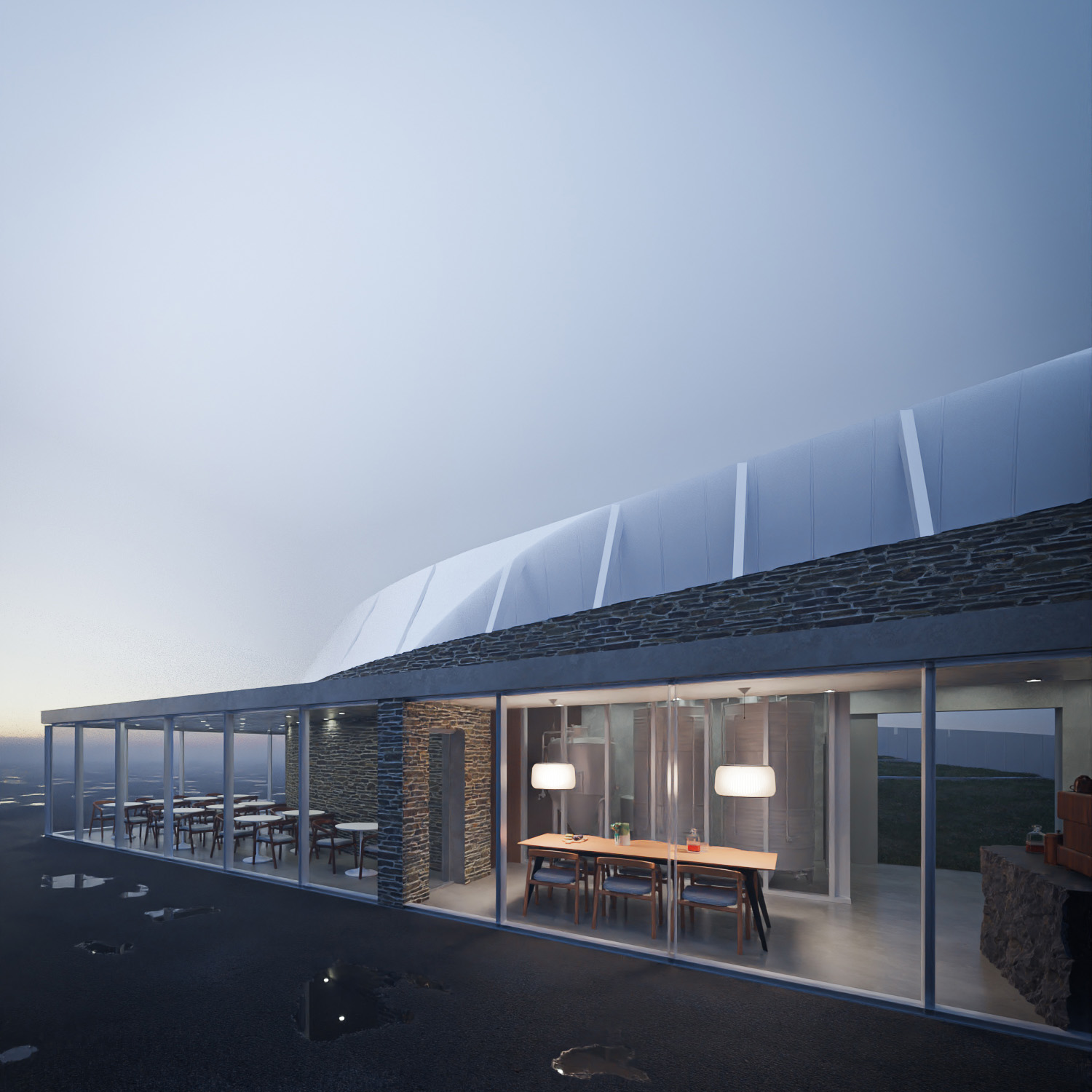
Rammed earth, with its layered construction and subtle color variations, establishes a massive and enduring language; elegant, natural, and warm, while ensuring privacy and protection. Service spaces and the Majlis share this materiality.
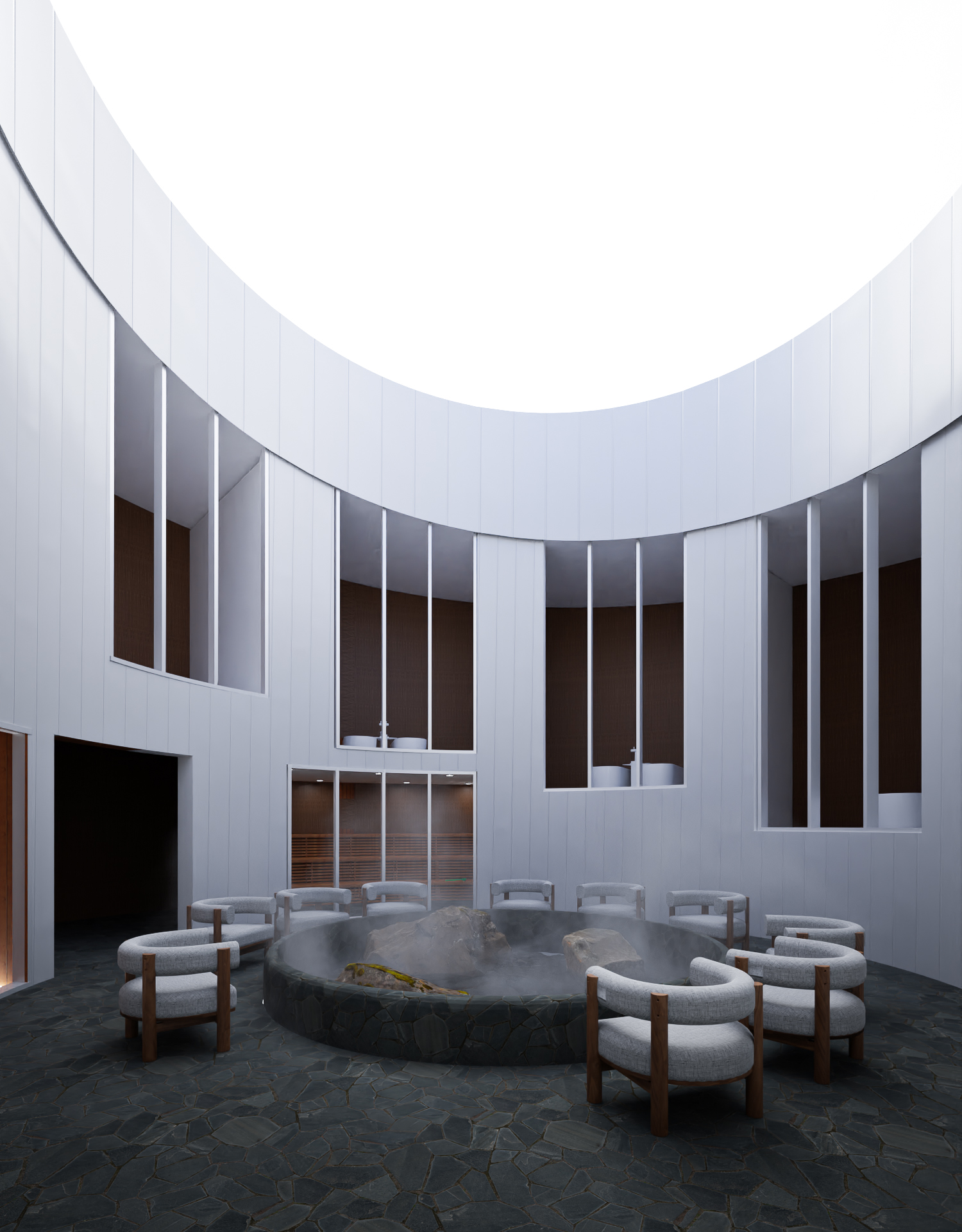
In contrast, the upper volume is wrapped in an elegant white veil, acting as a filter and counterbalancing the massiveness of the earth with a more aerial and lightweight expression.
Orientation plays a key role: The south-facing facades are fitted with contemporary, precise white vertical slats that elegantly fulfill their role as sunshades


Finally, the building materials for the project were carefully selected for their aesthetic, material, and durable qualities, as well as their ease of maintenance.
High recycled materials, sourced regionally, will help reduce resource and energy consumption and at the same time, the building's environmental footprint.
In addition to integrating sustainable construction systems, the project incorporates several strategies related to sustainable development. Ultimately, the goal is to reduce the building's ecological footprint. These strategies will have a positive impact on user comfort and building operating costs in the medium- and long-term span. To achieve energy-saving targets, there were considered multiple measures that will be implemented throughout the process, from design to construction.
Energy-saving measures are considered throughout the entire process, from design to construction:
High-performance glazing will be achieved though the glass envelope
Portions of the façade will be composed of frosted glass to significantly reduce solar heat gains and glare.
Clear glass areas are positioned beneath a generous canopy, which acts as a sunshade. The orientation of the main facade is also used in the project to achieve these bioclimatic qualities.
Inside, air stratification strategies take advantage of the double-height architectural staircase, and natural roof ventilation may be incorporated to reduce environmental impact.
Additional energy-efficiency measures include LED lighting, motion sensors, heat and cool recovery, and displacement ventilation.
In essence, Residence of Remembrance is conceived as a quiet dialogue between earth and light, a dwelling where memory, climate, and human presence are gently interwoven. Rising from the ground in layered rammed earth and wrapped above in a luminous veil, the architecture balances mass and lightness, intimacy and openness, permanence and change.
Spaces unfold like a contemplative journey, guided by filtered thresholds, shifting shadows, and framed encounters with landscape and sky. Rooted in vernacular wisdom yet expressed through a precise contemporary language, the project honors tradition while embracing renewal.
Sustainable in spirit as much as in technique, Residence of Remembrance becomes more than a home: it is a sanctuary shaped by time, atmosphere, and ritual, a place where earth anchors, light softens, and everyday life is elevated into quiet poetry.